
The European Innovation Scoreboard 2025 (EIS) is the European Commission’s annual report assessing the innovation performance of EU countries. This year’s edition introduces the biggest methodological change in years, making the report better reflect key economic trends: digitalisation, the green transition, and the real-world impact of innovation implementation. What does this mean for Poland?
The new EIS 2025 methodology includes 32 indicators grouped into four pillars: framework conditions, investments, firms’ innovation activities, and their impact on the economy. Both the structure and the weighting of individual measures have been revised to better show which countries not only invest in research, but also commercialise it effectively. The indicators place stronger emphasis on digitalisation, including the use of cloud services, AI and big data, as well as resource productivity, eco-innovation, exports of knowledge-intensive services, and tangible outcomes of R&D activity.
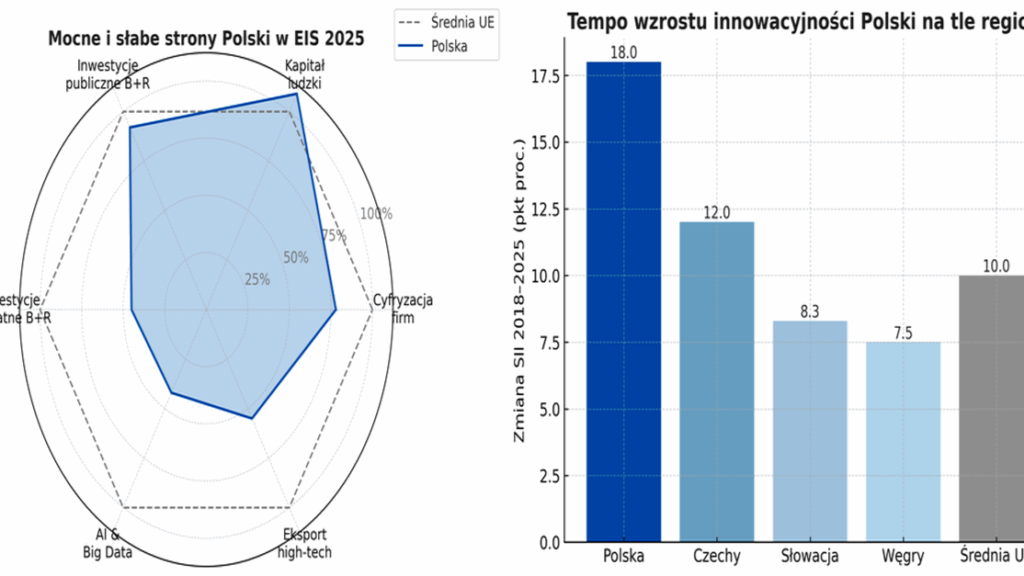
In EIS 2025, Poland reached 65.9% of the EU average, ranking 23rd among EU Member States. We still belong to the Emerging Innovators group-countries with innovation performance below 70% of the EU average, but the report clearly shows that we are developing rapidly. Between 2018 and 2025, Poland recorded an increase of 18 percentage points, the third-fastest improvement in the EU. This growth has been driven by factors such as EU funds, innovation support programmes, and improved digital infrastructure.
The report also highlights areas where Poland is catching up at an exceptionally dynamic pace. Access to broadband internet has improved significantly, with an increase of 68% over five years. Poland is also among the EU leaders in the development of cloud services, recording an impressive 389% growth, which places us 9th in Europe. . Government support for R&D rose by 57%, putting Poland in the top ten across the EU. The share of people with higher education is also increasing, strengthening the long-term human capital needed for an innovative economy.
At the same time, the report makes it clear that Poland still faces serious challenges. Private R&D expenditure remains very low—below 1% of GDP—which significantly limits companies’ capacity to develop their own innovations. We also recorded the largest decline in the EU in innovation investments outside R&D, at -48.5%. Poland remains at a low level in terms of patent applications and exports of high-tech products. The use of advanced technologies such as AI and big data is still limited, especially among SMEs. Cooperation between science and business is weak, we have relatively few joint R&D projects and co-authored publications compared to regional leaders.
Still, EIS 2025 clearly shows that Poland has a major opportunity. If we increase private investment in R&D, accelerate technology transfer and the commercialisation of research results, and develop employees’ digital competences, Poland has real potential to move into the Moderate Innovators group in the coming years. Equally important will be supporting the green transition, investing in eco-innovation, and internationalising Polish companies’ activities—particularly SMEs.
The report clearly indicates that the key to Poland’s growing innovation performance will be faster technology transfer, stronger commercialisation of research outcomes, and the development of digital competences. In this context, innovation hubs and support institutions have a particularly important role to play.