
The just transition of coal regions is a process that goes far beyond changes in the energy sector. It also encompasses the labour market, economic development, spatial planning, and cooperation between institutions and local communities. How can the experiences of other regions, available analytical tools, and the potential of innovation be used to establish sustainable foundations for the development of post-coal areas?
Answering this question requires a comprehensive approach that integrates different fields of knowledge and takes local conditions into account. This is particularly important for Eastern Greater Poland, where the transition away from a lignite-based economy creates the need to identify new development pathways for the region.
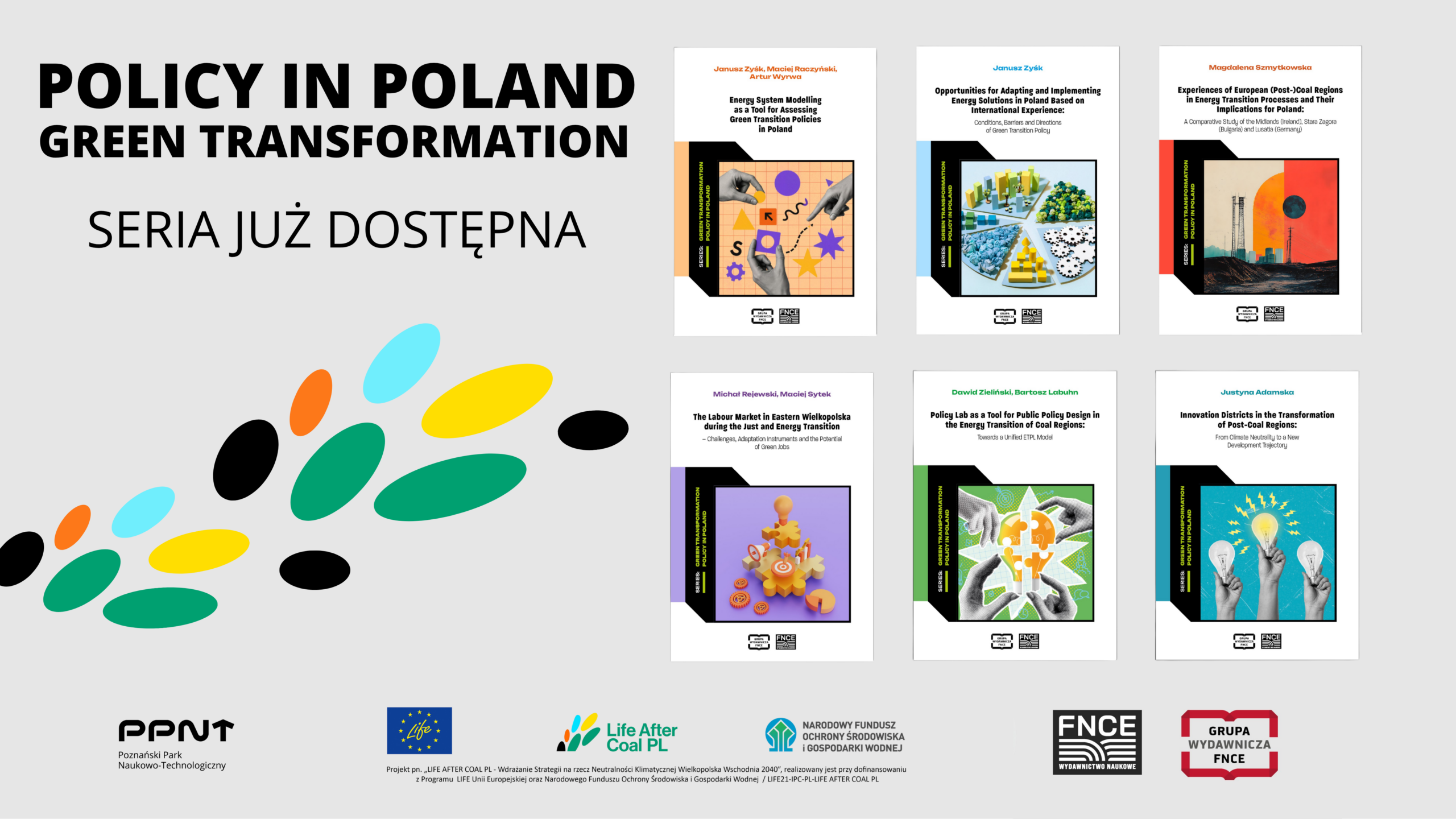
These issues are explored in a series of six monographs entitled “Green Transformation Policy in Poland”, published by FNCE Publishing House under the scientific editorship of Dominika Narożna, Prof. AMU, PhD, DSc, Member of the Board of the AMU Foundation. The series represents another outcome of the LIFE AFTER COAL PL project, coordinated by the Poznań Science and Technology Park, and builds on research conducted within the Eastern Greater Poland Policy Lab.
The publications explore key aspects of the just transition of coal-mining and post-coal regions, bringing together energy, social, economic, institutional, and spatial perspectives.
One of the essential elements of planning the green transition is energy system modelling. Analytical tools make it possible to assess different scenarios for changes in the energy sector and their potential consequences, providing valuable data for energy policy design.
The experiences of countries and regions undergoing similar processes are also an important source of knowledge. Examples from the Midlands in Ireland, Stara Zagora in Bulgaria, and Lusatia in Germany illustrate different approaches to the transformation of coal-dependent areas.
Analysing these experiences helps identify solutions that could also be applied in Poland. However, it is essential to consider the conditions required for their implementation, existing barriers, and the specific characteristics of individual regions. An effective transition is not about simply replicating foreign models, but about adapting proven solutions to local needs and capabilities.
The phase-out of coal mining affects employment structures and requires local labour markets to adapt to changing economic conditions. In Eastern Greater Poland, particular importance is attached to measures supporting workforce adaptation and opportunities for creating green jobs.
These changes must be considered within a broader economic context, taking into account not only new technologies but also demographic trends, available skills, and the region’s development potential.
One possible development pathway for post-coal areas is the establishment of innovation districts, which repurpose existing infrastructure and post-industrial sites to support new economic, research, and social activities.
This approach combines the redevelopment of physical spaces with the promotion of entrepreneurship, the development of local skills, and institutional cooperation. The objective is not only to find new uses for former mining areas but also to create conditions for developing new areas of economic specialisation.
The complexity of transition processes requires cooperation between public administration, academia, businesses, and local communities. One tool that brings these perspectives together is the Policy Lab, a collaborative approach to public policy design.
This approach involves identifying challenges, analysing available solutions, developing recommendations, and supporting their implementation. It enables scientific research findings to be translated into policies and measures addressing specific development challenges.
Within the Eastern Greater Poland Policy Lab, knowledge from various fields is used to develop recommendations for institutions and local authorities involved in the just transition process. Particular emphasis is placed on local conditions and the experiences of other European regions.
Research and experience from coal regions indicate that an effective transition requires coordinated action across multiple areas. Changes in the energy system should be linked to labour market development, the use of innovation potential, spatial redevelopment, and stronger institutional cooperation.
For Eastern Greater Poland, developing solutions that reflect the region’s specific characteristics and make use of its existing resources to create new development opportunities is particularly important.
The just transition is therefore not merely a process of moving away from coal, but also an opportunity to establish a new pathway for the region’s economic and social development.
Further reading:
The series of six scientific monographs entitled “Green Transformation Policy in Poland”, published by FNCE Publishing House. The authors include representatives of the Poznań Science and Technology Park: Justyna Adamska, PhD, and Dawid Zieliński, PhD.
Explore the publications on the FNCE Publishing House website